
Faux-Greek
Why debates about the historical accuracy of movies like “The Odyssey” miss the point of the story.

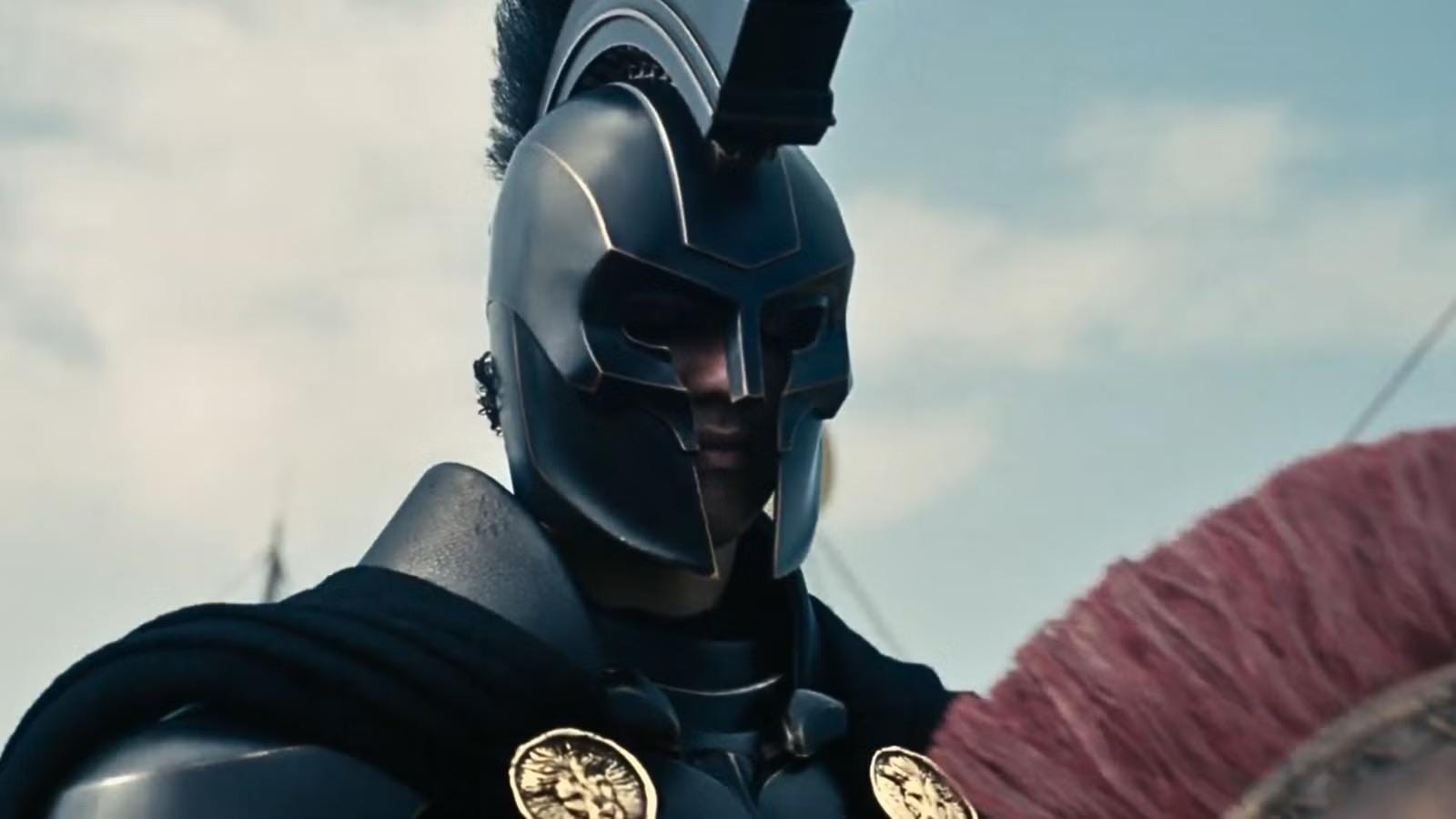
For cinephiles like myself, who worship at the Church of BIG movies on BIG screens, dropping the first image for The Odyssey was the equivalent to a religious awakening. But then I made a rookie mistake — I checked to see what the folks on Film Twitter Bluesky thought, and the posts I saw scrolling through my feed were about as predictable as Christopher Nolan’s color grading. It was a whole lotta “actually”’ and “gotchas,” pointing out every historical inaccuracy, from the details of the armor, filming locations, to whether or not Anne Hathaway looks good in blue (she does).
My sense of excitement was replaced with a sense of dread — nothing having to do with the movie itself, but because I could already see the waves of discourse that would be crashing onto my socials for the next year.
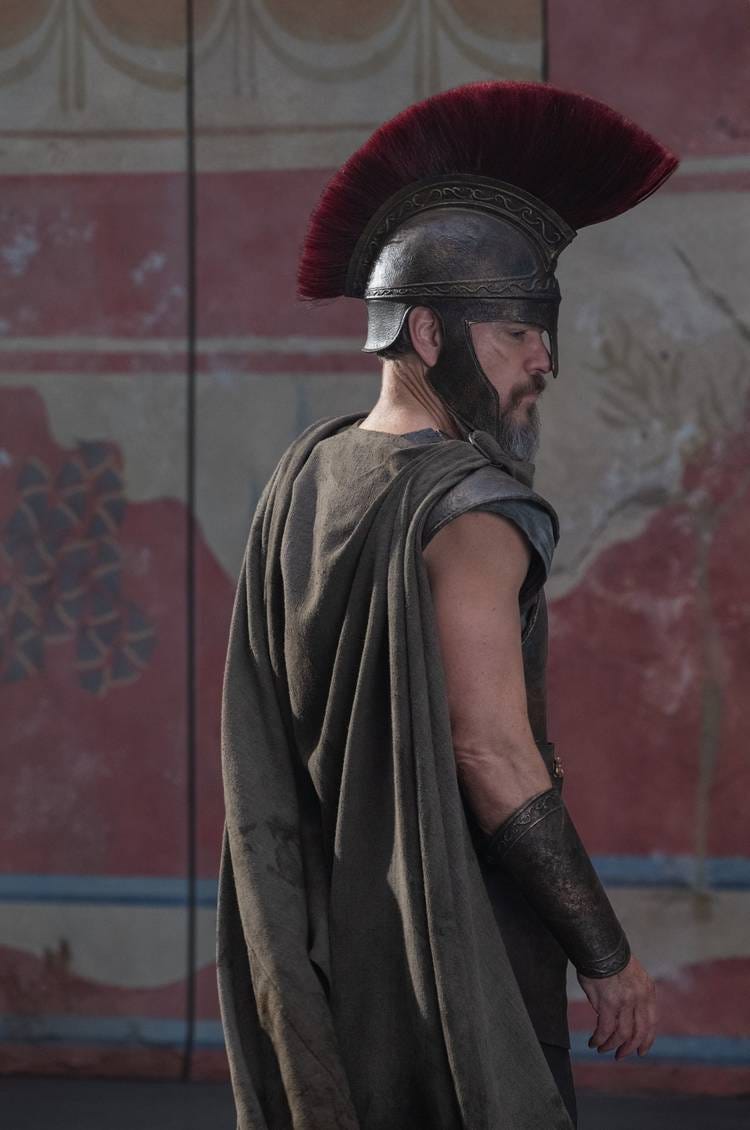
Is there any type of movie debate more dull than historical accuracy? It’s the equivalent to the comic book movie nerds who argue about Superman’s movie costumes (not that I would know, of course). There’s nothing wrong with having a preference or disliking a filmmaker’s choices, and Cinema is a visual medium, so aesthetics are important. The issue when people knock those choices without considering the context of the films themselves, or just to gain traction on YouTube.
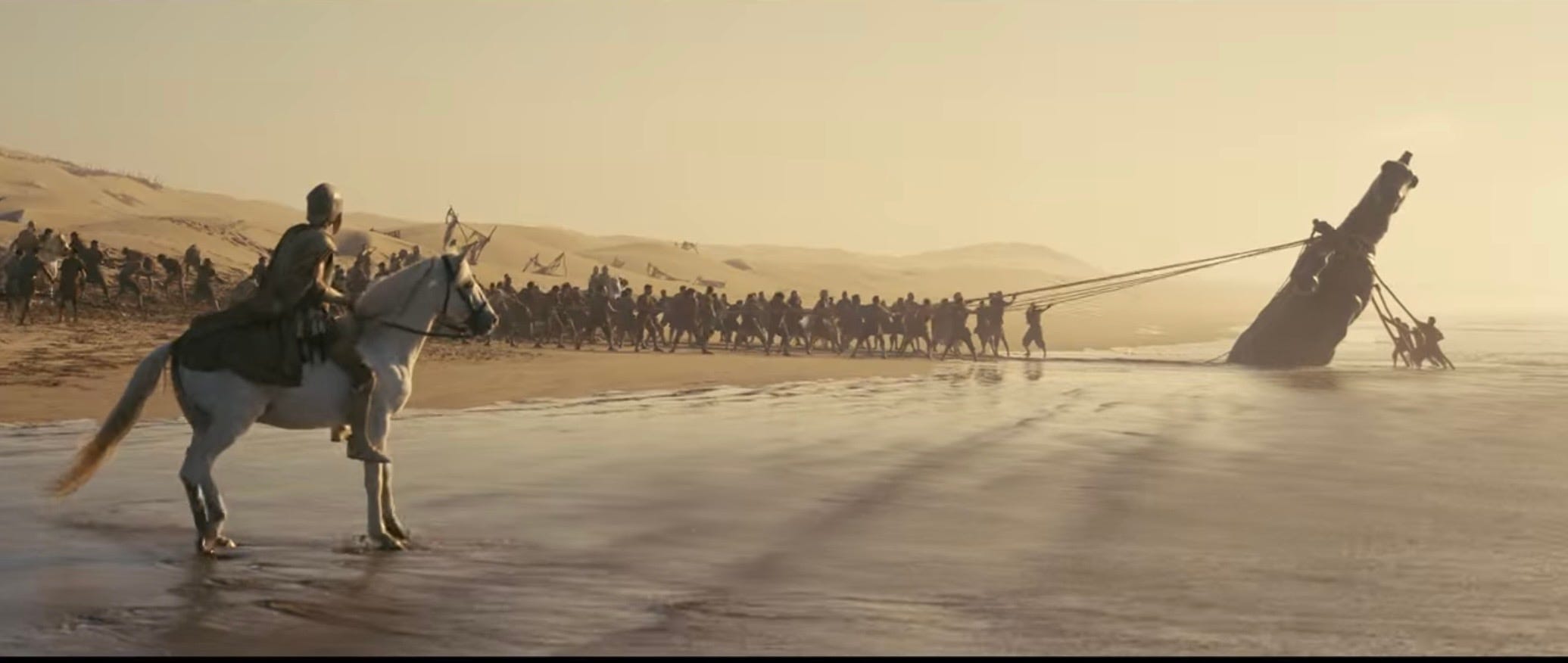
This piece is NOT a defense of a studio-backed multi-million doll at blockbuster by one of the most famous filmmakers working of all time, and neither am I going to bother speculating why Nolan and his team made these choices. I have no idea what Nolan has planned for bis version of The Odyssey. Could it just be a straight retelling, or does he have some subversive narrative twist up his sleeve? I’m not going to bother guessing. For all I know when Matt Damon gets back to Ithaca, Leonardo DiCaprio and Elliot Page will be there waiting for him — surprise, its Inception 21!
But with the armchair internet historian hive stirred up once again by the release of the new trailer, I wanted to take this opportunity to talk about historical accuracy in movies, specifically, why there often isn’t any, and why that’s a good thing.
Let’s rewind a bit. Back in 2023, Ridley Scott released Napoleon — in one of the early trailers there was footage of cannon balls hitting the Great Pyramids. A lot of people took issue with this, pointing out how not only was there no official record of one of the world’s great wonders being used for target practice, but that Napoleon’s army was never even close enough to make it a possibility.
So how did Ridley Scott respond? Well, instead of a properly cited quote, I present to you, dear reader, Sir Ridley Scott’s official response as interpreted by a Simpsons meme I threw together one night while I was high drunk at a soup kitchen.
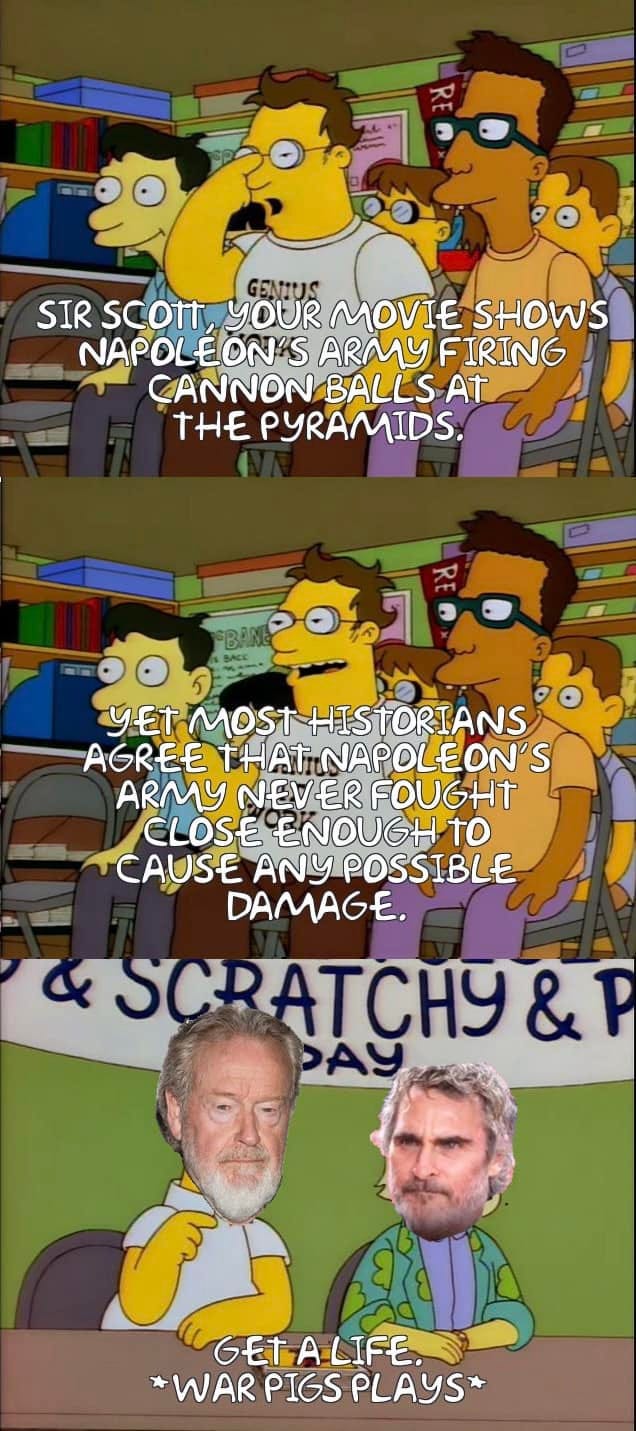
“Get a life!”
Now, that might seem harsh, but if directing both Alien and Blade Runner doesn’t give you the right to be snippy, then I don’t know what does.
Movies are not an historical record, unless they’re documentaries (many would argue not even then), but it’s important to keep in mind that what I’m talking about here are traditional narrative-driven films; things like Saving Private Ryan, Gladiator, or Troy — the latter of which Nolan almost directed.
When further questioned, Scott said that he chose that shot because it was good shorthand to communicate to the audience that Napoleon conquered Egypt. This wasn’t the first time Scott received that kind of criticism. The timeframe for Gladiator makes absolutely zero sense, to the point where the Colosseum shouldn’t even exist. The irony is that Scott is almost infamous for his attention to detail, especially when it comes to production design. But Scott is not an historian, he’s a storyteller, and ever choice he makes when designing the sets, props, and costumes is made to reinforce the story he’s trying to tell.
These are not historical reenactments, they’re movies; stories told through the lens of history. They use the imagery, facts, and events of the period to weave a narrative. “Based on a true story” is a common tagline used in marketing. “Inspired by true events” would probably be a more accurate one
Homer’s epics: The Iliad and The Odyssey, fit that same mold. Homer (if such a person even existed) was not transcribing first-hand accounts, but other stories, likely thousands, that were being passed down orally. Homer’s poems were also passed through the generations via oral traditions, until they were eventually transcribed. Even then, there multiple versions that would eventually filter down into what we have today. The point I’m trying to make is that we can’t mistake these folktales for actual history. It’s possible, perhaps even likely, that they reference real people and events, but we simply can’t say for sure.
This makes the exact time period for when these stories are meant to take place difficult to precisely nail down. What we do know comes from context clues based on the names of places and descriptions from the text itself. What we do know is that Homer’s poems were likely composed sometime between the 5th and 9th century B.C.E, though the earliest complete written versions only date back to the medieval period.
Plus, there’s a cyclops, clearly Homer wasn’t going for a straight historical account, for as we all know, those went extinct shortly after aliens abducted the dinosaurs and sent them to Mars.
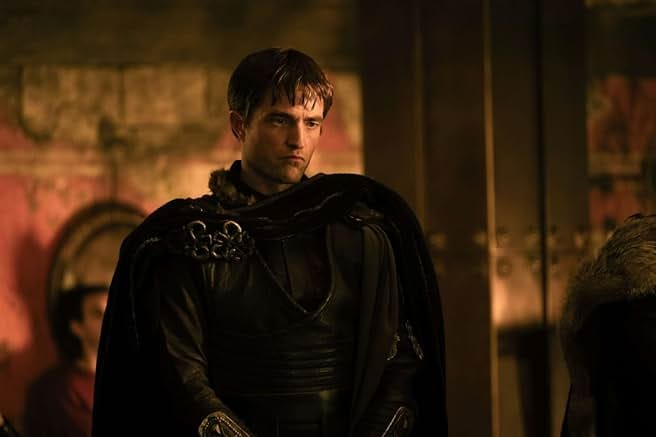
So, what does this have to do with people complaining about helmet designs online? The Odyssey is not about history. It’s about a man trying to get home from war. Odysseus’s journey has been interpreted in countless ways, James Joyce’s Ulysses to the Coen brother’s O Brother, Where Art Thou? Nolan’s will be just one more version passed down through time. What most of these interpretations have in common is that they are rarely about how Greek soldiers dressed or what the exact geographical outline of the Mediterranean Sea was at the time. They’re usually about stuff like the trauma of war, humanity’s endless struggle against the natural world, and how some guys will spend a decade away lost at sea rather than ask for directions. These the kinds of things the poem concerns itself with. It doesn’t talk much about the look of the time period where it’s from or describe the ship Odysseus sails in any more detail than is necessary to understand the next adventure.
But that’s the poem. This is a movie, and movies have a language all their own. A visual language. I want to illustrate my next point by breaking down this single frame from the trailer:
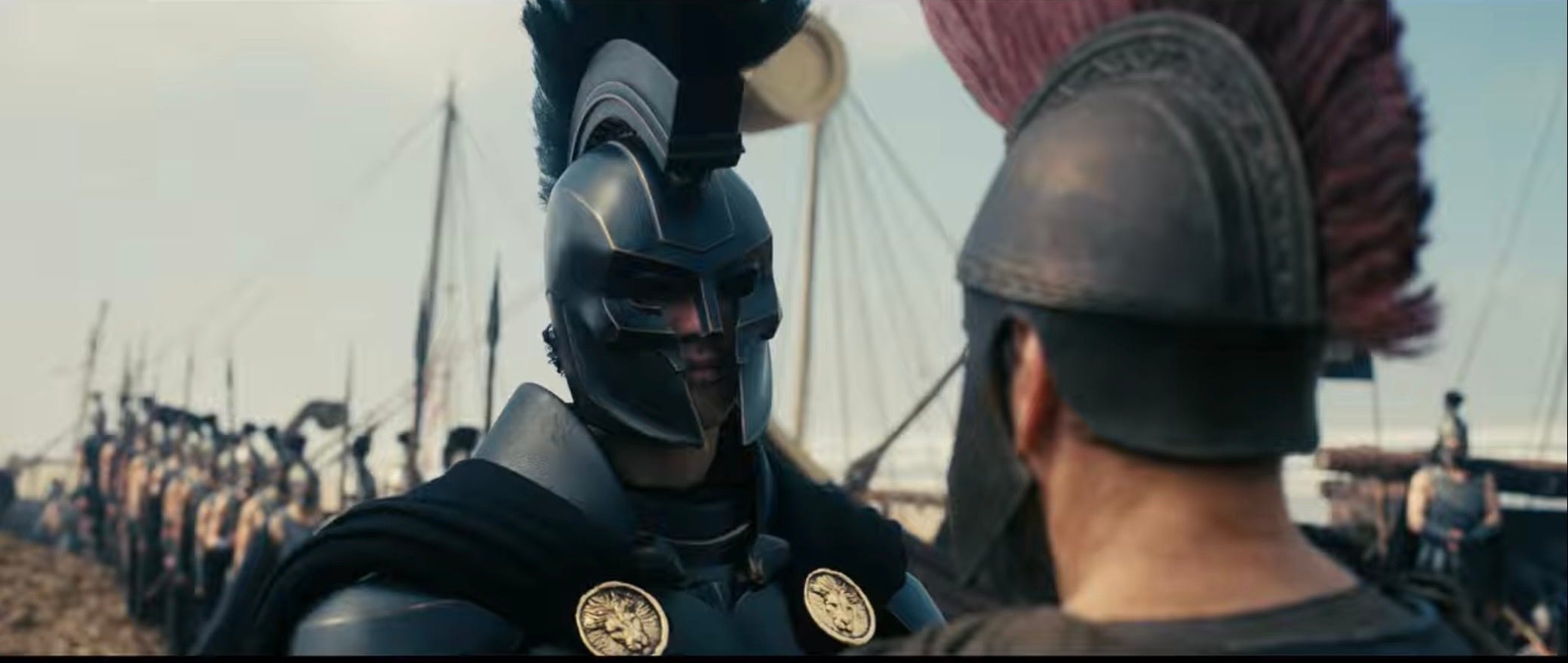
The style of the armor shown here is more than expression of a time and place, it’s an expression of character and what is happening in the story. I don’t know who these guys are nor do I have much context for this scene, but going by what is shown, there’s a lot happening here. The blocking indicates that the player in the foreground, armor lighter and more weathered, is subservient to the one in darker armor, new and pristine. It suggests a high rank, maybe someone who isn’t even in the fray all that often, hence the untouched look. The broader build gives the impression of dominance, and the eyes covered in shadow give him an ominous, almost inhuman aura. He looks like the personification of the void of war itself, or perhaps death. All that is just speculation, of course. For all I know that’s just three ducks stacked on top of each other in disguise.
It’s perfectly reasonable to say that Nolan’s apparent vision of Greek mythology doesn’t appeal to your personal taste — personally, I think he could stand to add some brighter colors once in a while — but at the end of the day, this is a Christopher Nolan film. He has a vision and a style he works in, and at this point, you’re either in for the journey or not getting on the boat at all. I don’t blame anyone who chooses not to sail these seas, they’re a bit rocky, the journey can be long, and the audio mixing is weird.
Those are all reasonable concerns. But if all you’re focused on is the accuracy of Matt Damon’s cloak, then you’ll be missing out on the real details. Look, I have no idea if Christopher Nolan’s The Odyssey will be any good, but what I do know is that it will have little to do with whether his breast plate is the right size.
Just kidding. Obviously, it’s a new Batman movie. Benny Safdie is playing Maxie Zeus.
I think the Hollywood criteria for period costumes, gear, and related paraphernalia come down to things like form-fitting pantaloons regardless of whether there were actual form-fitting pantaloons at the time of the setting of the stories, helmets that look like ready merch for the promos when the real-life helmets were ungainly and migraine-inducing, and colors that look good on certain actors when color-coordination was reserved for the upper crust.
I'm still trying to wrap my head around Joaquin Phoenix as Napoleon. I thought that sort of thing was put paid to rest after Keanu Reeves as the Prince Shakyamuni. Then again, there's a long history of that sort of thing - re John Wayne as Kublai Khan ("my blood says...take her!").